The numbers are difficult to ignore. According to recent industry data, fast-moving consumer goods — the category that includes food and beverage — is the only manufacturing sector where unplanned downtime hours have increased over the past five years. Every other major sector cut its downtime. Food and beverage went the other direction, with per-plant downtime costs roughly doubling to over $10 million a year.1
The diagnosis isn’t that food equipment fails more often than equipment in other sectors. It’s that food and beverage was slower to adopt the predictive maintenance and process monitoring technology that let other industries get ahead of failures before they happen. The per-hour cost of a food plant stoppage — around $36,000, versus $2.3 million in automotive — made predictive maintenance look like a weaker investment case.2 So the sector waited.
The waiting is getting expensive.
The Problem Is Structural, Not Just Technical
Two trends are converging to make the downtime problem worse. U.S. fixed assets now average 24 years old — the oldest since 1947 — meaning a generation of capital equipment is reaching the point where it demands attention.1 At the same time, the experienced maintenance staff who knew those aging machines best are retiring, and recovery time from a stoppage has climbed from 49 minutes in 2019 to 81 minutes as institutional knowledge walks out the door.2
Most plants know this. In a 2026 survey of more than 2,200 maintenance leaders by MaintainX, 64% said they run a preventive maintenance program — yet half of all teams spend less than 40% of their time on planned work.3 The rest goes to reacting to failures that were, in many cases, predictable. Thirty-six percent of those leaders named labor shortages as a reason downtime increased, and 28% pointed to a lack of necessary skills on the team.3
The gap between stated strategy and actual practice is the gap that inline process monitoring closes.
Seam Inspection: Turning a Reactive Problem into a Scheduled One
Seamer failures are among the most consequential unplanned stoppages on a canning line. A seaming head whose rolls have worn past tolerance doesn’t fail suddenly — it drifts. Seam thickness decreases gradually. Overlap approaches its lower limit over hours or shifts. By the time a teardown confirms the problem, product has been put at risk and a hold investigation has begun.
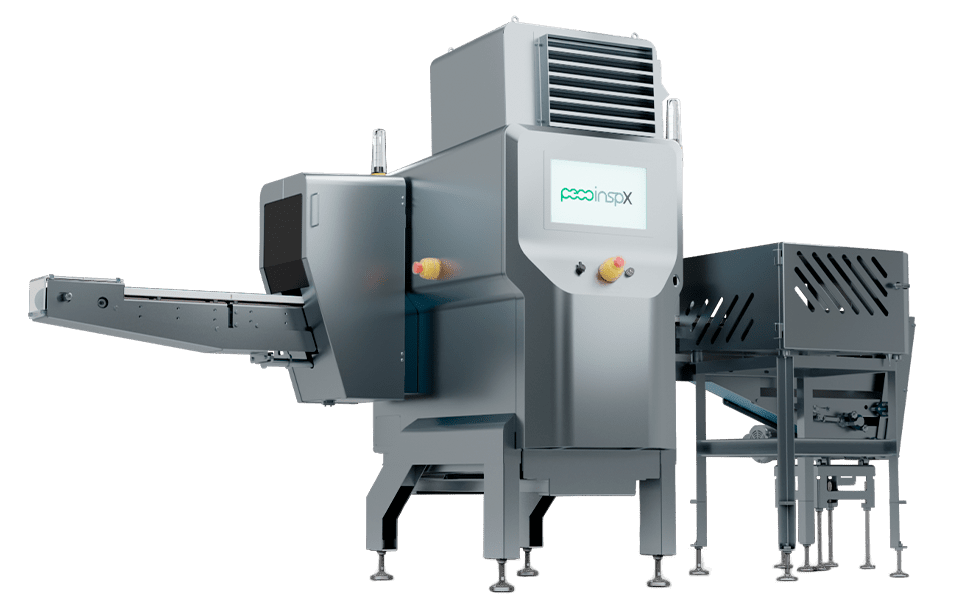
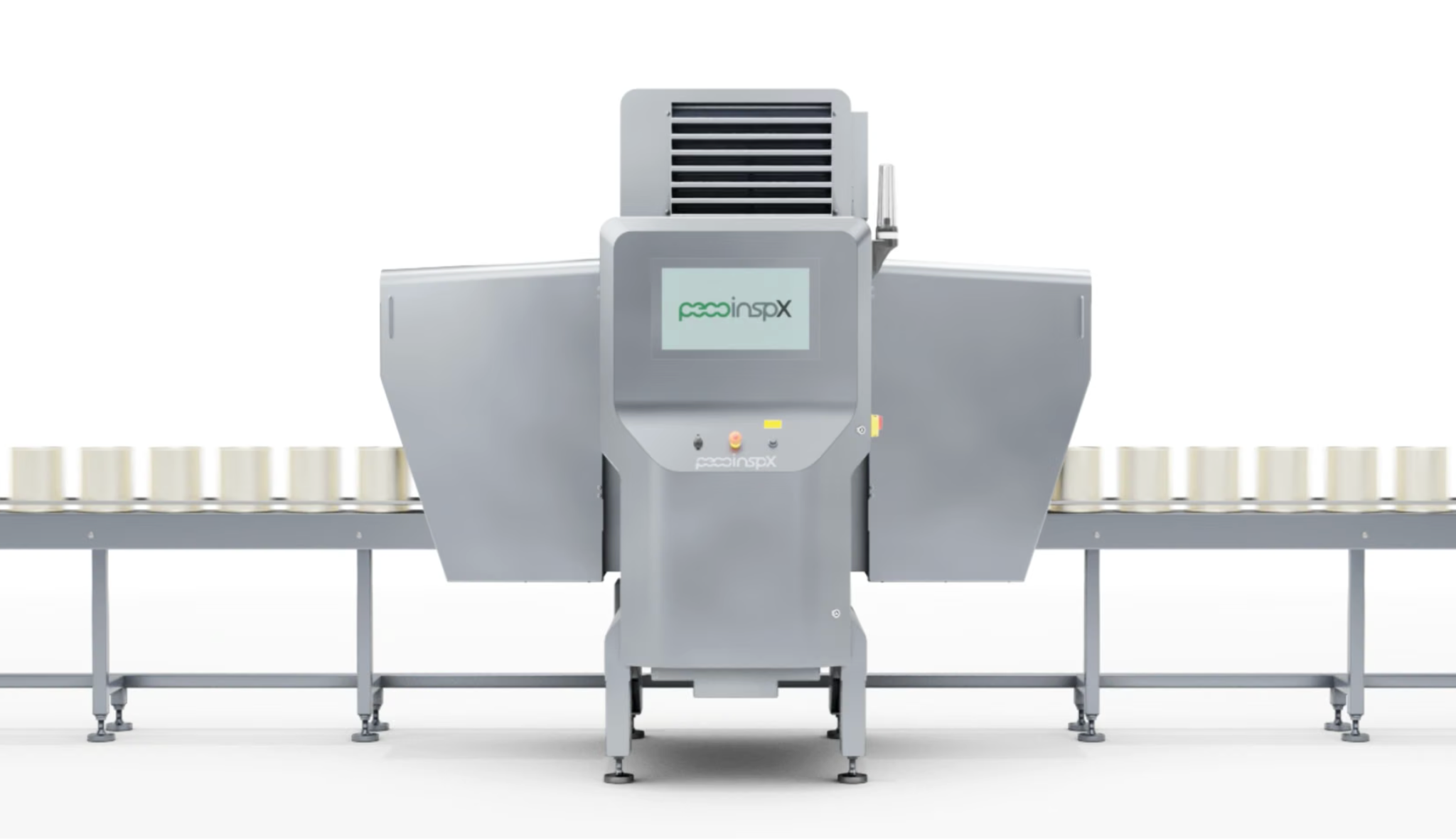
The Peco InspX Legato is designed to make seamer drift visible before it becomes a failure. Deployed inline after the seamer, the Legato captures a 360-degree X-ray profile of the double seam on every can at line speed. Its seamer monitoring function attributes each measurement to the specific seaming head that produced it — so when a head begins to trend toward its limit, the maintenance team sees it in real time, while the head is still in specification.
The maintenance response changes completely. Instead of an emergency roll replacement after a failure, it becomes a scheduled inspection at the next planned downtime window. Instead of a product hold and root cause investigation, it becomes a line note and a maintenance ticket. The hour count that has been climbing across the food sector goes down — one seamer, one avoided stoppage at a time.
Checkweigh: Eliminating Mechanical Failure Points
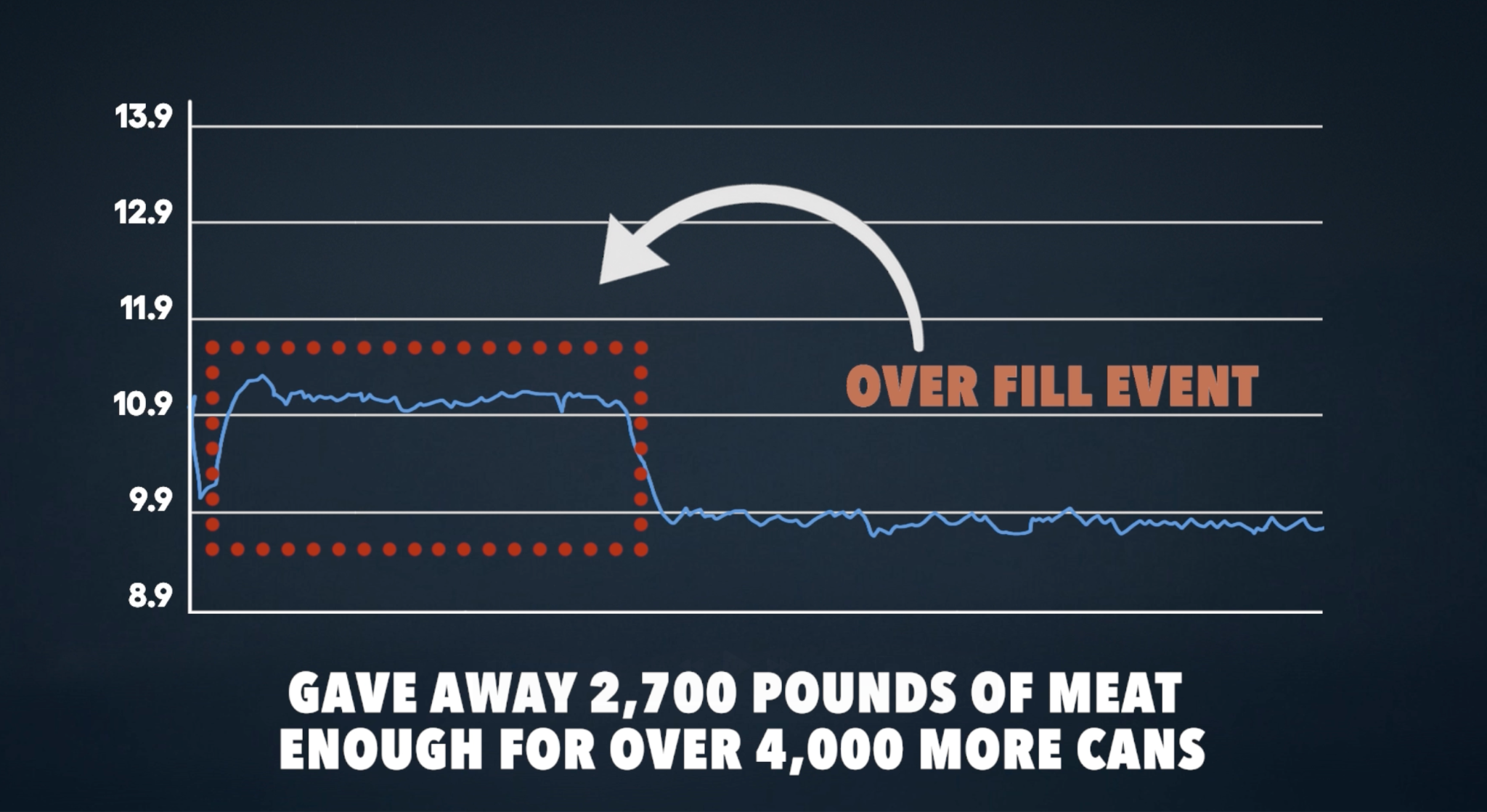
Mechanical checkweighers are reliable workhorses, but they are also a source of the reactive maintenance burden that consumes so much of the average food plant’s maintenance hours. Reject mechanisms jam. Scales drift with temperature. Calibration intervals demand planned downtime. When a mechanical checkweigher goes down on a critical line, it takes the line with it.
The Peco InspX Solo removes these failure points by replacing mechanical weighing with X-ray measurement. There are no moving parts in the measurement path, no reject mechanism to jam, and no tare variation to account for — because the X-ray beam measures the attenuation of the product itself, not the total package weight.
Beyond eliminating the mechanical failure mode, the Solo’s checkweigh function attributes every weight measurement to the originating filler valve. When fill weights begin trending low on a specific valve, the Solo identifies both the deviation and its source — giving maintenance a precise target rather than a full filler teardown. That per-valve attribution is exactly the kind of condition-based intelligence the sector has been underinvesting in: information that converts a reactive response into a scheduled one.
The Solo also performs simultaneous foreign material detection alongside checkweigh, addressing two regulatory requirements with a single system and a single maintenance burden.
Empty Glass X-ray: Stopping Defects Before They Enter the Line

For glass packaging operations, a significant and often underestimated source of unplanned downtime originates before a single drop of product is introduced: defective or contaminated empty containers reaching the filler.
The root cause of the problem has been getting worse. The increased use of cullet glass — recycled glass used in bottle production — has introduced greater variability in glass quality, raising the incidence of defects including inclusions, thin sidewalls, shards, chipped necks, inconsistent heights, and finish defects.4 A structurally compromised bottle that passes visual inspection undetected doesn’t announce itself until it reaches the filler or capper — where the pressure and mechanical forces of the filling process cause it to break. Each such event requires stopping the line, clearing the breakage, and sanitizing the area before production can resume. At 5 to 8 minutes of downtime per incident, even a modest frequency of defective containers reaching the filler represents a meaningful and recurring drain on production time. Recent recalls in the glass packaging sector involving chipped necks and glass fragments underscore how quickly a container quality problem also becomes a brand and regulatory problem.4
Peco InspX X-ray inspection systems for empty glass containers address this at the source, inspecting every bottle inline before filling at speeds exceeding 1,200 packages per minute — fast enough to integrate into high-speed production lines without creating a bottleneck.4 The structural defects that X-ray detects — thin sidewalls, inclusions, bent neck, swung baffle — are precisely the ones that optical inspection misses and that predict which containers are likely to fail under the mechanical stress of filling and capping.
The downtime math is straightforward: a defective bottle caught before the filler costs a fraction of a second and one rejected container. The same bottle caught by the filler costs 5 to 8 minutes of stopped production, a cleanup, and the compounding effect of that disruption on the rest of the shift. Inline empty glass X-ray inspection is one of the clearest examples in food and beverage manufacturing of a quality investment that pays for itself in uptime.
The Investment Case Has Changed
The per-hour cost argument that once kept food and beverage from investing in predictive maintenance has been overtaken by two developments: annual downtime costs have doubled, and the technology has become substantially more accessible.
The world’s 500 largest companies lose approximately $1.4 trillion a year to unplanned downtime — equal to roughly 11% of revenue — with the average large plant losing $253 million annually when lines stop unexpectedly.2 More than half of maintenance teams are already using AI-assisted tools in some form, and 75% of leaders who adopted them reported measurable returns within six months.3
Inline X-ray inspection systems from Peco InspX are designed to do more than detect defects. They generate continuous process data — per-head seam geometry trends, per-valve fill weight histories, container-by-container inspection records — that feeds directly into the condition-based maintenance programs that have allowed other sectors to cut their downtime hours while food and beverage’s hours climbed.
The enabling technology is no longer experimental or cost-prohibitive. What remains is the decision to connect inspection data to maintenance action — to treat the information a Legato, Solo, or Trio generates not as a quality record, but as a maintenance signal.
The sectors that made that connection earlier are losing fewer hours. Food and beverage still has ground to recover. The tools to do it are available now.
References and Further Reading
Peco InspX has been delivering inspection solutions for the food and beverage manufacturing industry for over 60 years. Headquartered in Burlingame, California, Peco InspX designs and builds all inspection systems in the United States. Learn more at peco-inspx.com or contact info@peco-inspx.com.
Footnotes
- Morrison, K. (2026, June 23). Food and Beverage Is the Only Sector Losing Ground on Downtime. Food Industry Executive. https://foodindustryexecutive.com/2026/06/food-beverage-downtime-maintenance/ Covers five-year downtime trend data across manufacturing sectors, the aging U.S. fixed asset base (averaging 24 years old as of 2026), and per-plant cost figures for the food and beverage category. ↩ ↩2
- Siemens. (2024). Siemens Downtime Report. Siemens AG. Industry-wide analysis of unplanned downtime costs, per-hour cost benchmarks by sector ($36,000 food/beverage vs. $2.3M automotive), and attribution of the FMCG downtime lag to slower adoption of predictive maintenance technology. Recovery time increase from 49 to 81 minutes also sourced here. ↩ ↩2 ↩3
- MaintainX. (2026). 2026 State of Industrial Maintenance Report. MaintainX. Survey of more than 2,200 maintenance leaders. Key findings: 64% report running a preventive maintenance program; fewer than half spend 40% or more of their time on planned work; 36% cite labor shortages as a driver of increased downtime; 28% cite skills gaps; 58% are using AI in some form; 75% of AI adopters reported measurable ROI within six months. ↩ ↩2 ↩3